The Big Five explains less than half the variance in relationship outcomes. What if we treated personality the way CLIP treats images — embedding everything, unsupervised, at the resolution reality demands — and asked not "do these two people match?" but "what kind of relationship will they build?"
Born from the Love Symposium research community in San Francisco and covered in The New York Times, this workshop brings the relationship prediction research program to the NeurIPS stage.
We are living in a social dark age. The tools we use to form relationships — swiping on photos, answering personality quizzes — operate at a resolution so low that they're the equivalent of trying to recognize a face from a 4×4 pixel grid. Married people report happiness equivalent to a $50,000 salary increase. Finding a one-in-a-million match instead of a one-in-a-hundred doesn't make someone a little happier — it satisfies something at the level of the soul. And yet we have no serious research infrastructure for building the representations that would make this possible.
This workshop's thesis: personality can be embedded the way CLIP embeds images — in high-dimensional, unsupervised vector spaces learned from massive multimodal data — and relationship outcomes can be predicted as structured manifolds, not scalar compatibility scores. The style-GAN moment for personality embeddings is imminent. The stable-diffusion moment is perhaps three years away.
The field of human emotion embedding already had its breakthrough — Alan Cowen's work at Hume AI demonstrated that self-reported emotion labels are a lossy pre-CLIP taxonomy, and that unsupervised high-dimensional representations recover structure invisible to prior frameworks. We propose extending this to the full personality, and from there to dyadic relationship outcome prediction.
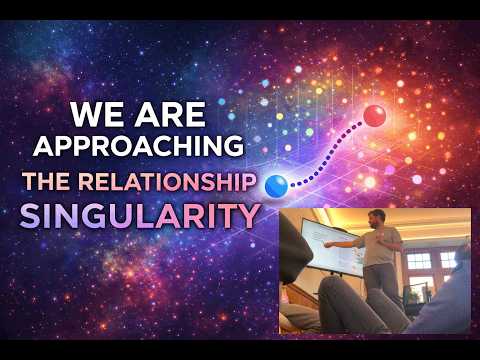
Relationship Outcome Prediction Tech — Matthew Fisher at Love Symposium, San Francisco (November 2024). A two-hour tour through the full research program: personality embedding spaces, the Cultural Trope Hypothesis, emotion manifolds, Moneyball mutual attraction, LLM relationship simulation, and the path to the Relationship Singularity.
We invite submissions at the intersection of machine learning and human relational dynamics:
Building an interdisciplinary lineup across ML, psychology, industry, and computational social science.
Full-day workshop (7-9 hours). Subject to revision.
| Time | Session |
|---|---|
| 9:00 | Opening: The Case for High-Dimensional Relationship Science talk |
| 9:30 | Keynote I: From Emotion Taxonomies to Emotion Manifolds keynote |
| 10:15 | Contributed Talks I (3 × 12 min) oral |
| 10:50 | ☕ Break |
| 11:20 | Keynote II: Personality Representation Beyond the Big Five keynote |
| 12:00 | Contributed Talks II (3 × 12 min) oral |
| 12:35 | 🍽 Lunch & Poster Session |
| 14:00 | Keynote III: Simulating Relationships with LLM Agents keynote |
| 14:40 | Panel: Can We Predict Relationships — and Should We? panel |
| 15:30 | ☕ Break |
| 16:00 | Keynote IV: Industry Perspectives on AI-Mediated Connection keynote |
| 16:40 | Contributed Talks III + Spotlight Posters oral |
| 17:20 | Closing: Open Problems & The Road to the Relationship Singularity |
Extended abstracts up to 4 pages (excluding references) in NeurIPS 2026 LaTeX format. Double-blind review via OpenReview. Non-archival; concurrent submissions permitted.
Research — Methods, experiments, theory for personality representation, relational prediction, or social AI.
Benchmarks & Datasets — Evaluation frameworks, new datasets, reproducibility studies.
Position Papers — Ethical, social, and technical perspectives on AI-mediated connection.
At least one author must attend in person. Selected papers get oral slots; all accepted work presents posters. Submission portal opens upon workshop acceptance.
All deadlines 23:59 AoE. Timeline extrapolated from NeurIPS 2025.
Assembling 4-6 organizers across ML, psychology, computational social science, and industry.
Sponsorship supports student travel grants, poster logistics, and invited speaker travel to Sydney.
Tiers from $5,000-$20,000. Contact us for the prospectus.